
Recently, the Ministry of Industry and Information Technology (MIIT) released its 411th batch of the Announcement of Road Motor Vehicle Manufacturers and Products, listing nearly 20 new vehicle models. Though the total count falls short of peak levels, the lineup is exceptionally high-caliber: Wey's all-new Lanshan debuts as a 'luxury box-shaped SUV'; the Avatr T09 — the first flagship SUV co-developed with Huawei — makes its debut appearance; and both the fuel-powered BMW L and the long-wheelbase i3 BEV variant are simultaneously announced — signaling a new wave of premium, intelligent vehicle deliveries from late 2026 through early 2027.
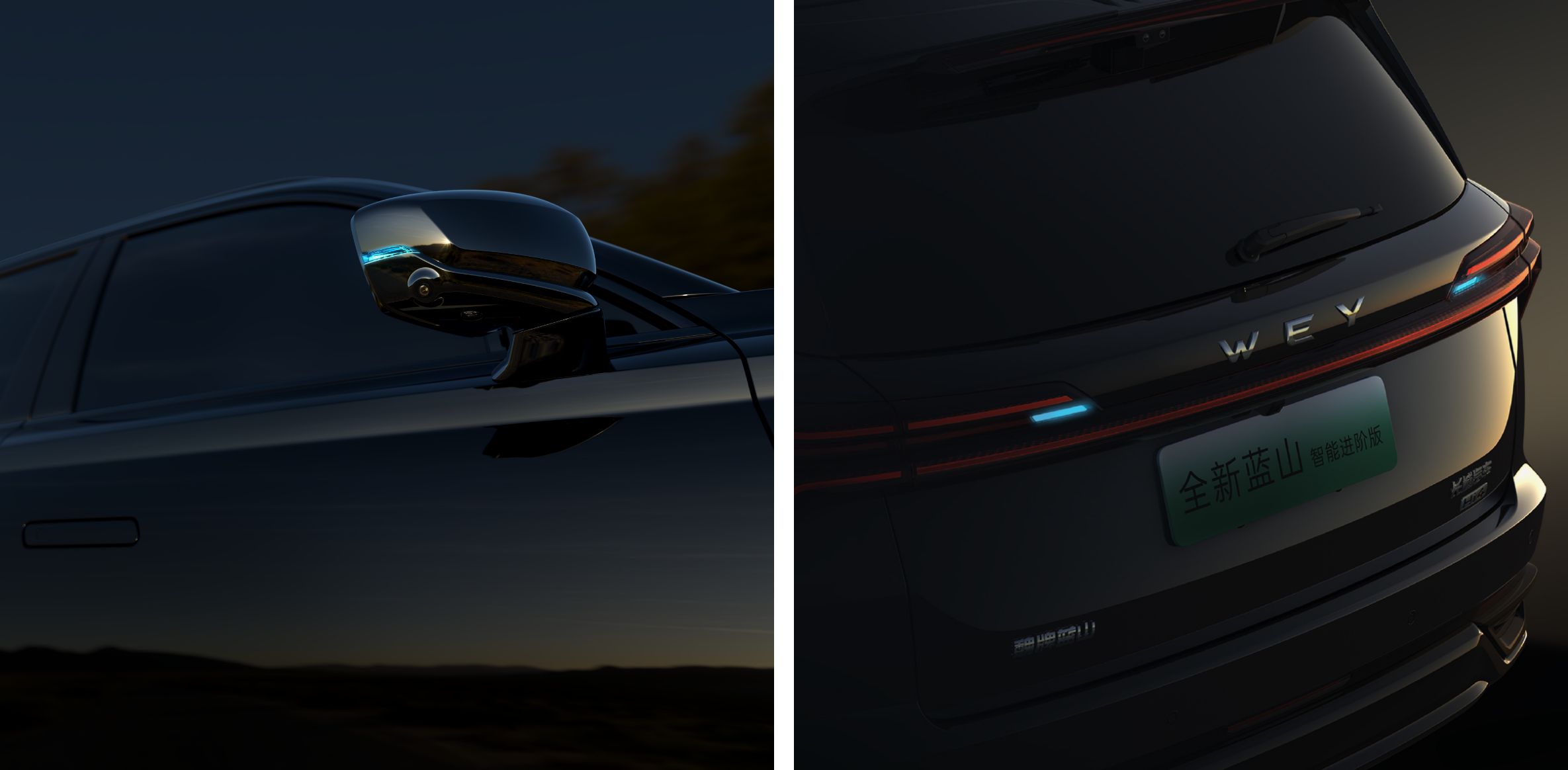
Among them, Wey's all-new Lanshan stands out most prominently. Built on the same platform as the Wey P8, it offers two body lengths — 5140 mm (5-seater) and 5300 mm (6-seater) — with a width of 2050 mm and height of 1960 mm; both variants share a uniform wheelbase of 3010 mm, making it wider and taller than the current model. Its design features a rugged, boxy silhouette: a vertical-slat front grille houses an illuminated Wey logo at center, flanked by retro-style round headlights and integrated LiDAR units; the rear features an externally mounted spare tire and split vertical taillights, reinforcing its off-road identity. Powertrain options include the E20NB 2.0T gasoline engine (max output 182 kW) paired with BYD's Hi4 plug-in hybrid architecture — featuring front and rear motors rated at 110 kW and 220 kW respectively. Batteries are supplied by CATL's ternary lithium cells, available in two capacities: 53.6 kWh (WLTC all-electric range: 220 km) and 64.7 kWh (WLTC all-electric range: 270 km), delivering WLTC combined fuel consumption of 6.80 L/100 km and 6.90 L/100 km respectively. Top speed ranges from 205–210 km/h. Wey CEO Zhao Yongpo previously confirmed the model will officially launch in Q4 2026, targeting the RMB 300,000 segment.
The Avatr T09 represents a new benchmark for intelligent electric SUVs. As the first flagship model jointly designed by Avatr and Huawei, it positions itself as a full-size luxury SUV measuring 5285 mm (L) × 2025 mm (W) × 1810 mm (H), with a 3150-mm wheelbase and 6-seat configuration. It debuts with an intelligent super hybrid system offering two powertrain options: a 2.0T + triple-motor setup (peak outputs: 180 kW / 225 kW / 225 kW) or a 1.5T + dual-motor setup (110 kW / 180 kW / 310 kW). Both pair with CATL's Xiaoyao Super Range-Extending Hybrid Battery (71.24 kWh), delivering over 400 km CLTC all-electric range and 300–330 km WLTC all-electric range. Chassis technology integrates Huawei's XMC digital chassis and Taihang intelligent control systems, enabling rear-wheel steering and crab-walking mode, with a minimum turning radius of approximately 4 meters. Notably, the vehicle is slated for official unveiling this year, though its market launch timing remains unconfirmed.
Additionally, the newly announced fuel-powered BMW L lists two engine options: the 30L variant (2.0T B48B20N, 211 kW) and the 40L variant (3.0T B58B30L, 327 kW), with a 3165-mm wheelbase — expected to go on sale in 2027. Meanwhile, the new long-wheelbase BMW i3, built on an 800V high-voltage architecture and equipped with the sixth-generation eDrive electric drive unit (single motor: 235 kW), achieves up to 912 km CLTC all-electric range and enters production in January 2027. Other models — including the GAC Aion M8, updated GAC GS8, Geely Galaxy L9, and Yipai EP7 battery-swapping version — also appear in this announcement, covering plug-in hybrids, BEVs, battery-swapping, and conventional ICE powertrains.
Comments
0 commentsNo comments yet. Be the first!
Post Comment