
Design: Big Doesn't Mean Bulky — Six Seats, Balanced by Default
The 2026 Li L9 Livis isn't just a minor refresh — it measures 5255 × 2000 × 1810 mm (L × W × H), with a wheelbase of 3125 mm and a curb weight of 2835 kg (up to 3435 kg when fully loaded). For a six-seat full-size SUV of this scale, conventional wisdom has long held that 'large equals unwieldy': tight U-turns feel laborious, cornering induces noticeable body roll, and rough roads trigger frequent cabin shake. The Livis, however, tackles these perceptions head-on — starting from the ground up — with an entirely redefined chassis architecture designed to shatter the 'bigger = less agile' stereotype.
The most immediate change comes from its full-drive-by-wire chassis: steer-by-wire eliminates the mechanical steering column; rear-wheel active steering offers ±7° adjustment; and EMB (electro-mechanical braking) replaces hydraulic lines — cutting signal latency to just 10 ms (vs. ~220 ms for traditional hydraulics). In real-world testing in TownCar's narrow alleys, the Livis achieved a turning radius of just 5.4 meters — allowing it to complete a U-turn in one go despite exceeding 5.2 meters in length. Its maneuverability in underground parking lots far exceeded expectations.
Powertrain: Can the 5C Extended-Range System Truly Deliver Both Quietness and Range?
Li's in-house-developed 5C extended-range powertrain is now production-ready: a third-generation 1.5T four-cylinder range extender rated at 115 kW, paired with a 72.7 kWh ternary lithium battery delivering a CLTC pure-electric range of 420 km. During our week-long urban commute, the range extender never activated — the EV-like driving experience was indistinguishable from a pure BEV. With six passengers aboard on highway runs, real-world fuel consumption measured 5.7 L/100 km (WLTC-rated at 6.4 L/100 km), outperforming most competing extended-range SUVs in its class.
All-wheel drive delivers a combined 420 kW / 710 N·m, enabling a 0–100 km/h sprint in just 4.9 seconds. Power delivery is smooth and linear — no jerkiness or abrupt surges — whether pulling away from traffic lights or overtaking at speed. The system clearly prioritizes refinement over raw aggression.
Intelligence: Mach ADAS — Going Beyond 'Seeing Clearly'
The Livis features Li's proprietary Mach Advanced Driver Assistance System (ADAS), powered by two 5nm-process Mach M100 chips (1280 TOPS each, totaling 2560 TOPS), four LiDAR units, seven 8-megapixel cameras, and UWB near-field sensing modules. Its 300-meter forward detection capability proved robust in complex scenarios like highway ramp merges and construction zone cone navigation. At TownCar intersections, the system reliably detected and reacted to jaywalking pedestrians and crossing non-motorized vehicles — braking earlier than many mass-market systems.
The key breakthrough lies in deep integration between chassis and ADAS: upon detecting road irregularities or curves, the system proactively coordinates suspension, steering, and braking adjustments. With NOA engaged, body control feels markedly more refined than on conventional mechanically linked platforms. Currently classified as L2++, the system does not yet offer map-free urban navigation in TownCar, but clear OTA upgrade paths are underway.
Riding Comfort: Four Zero-Gravity Seats — Not a Gimmick, But Standard Equipment
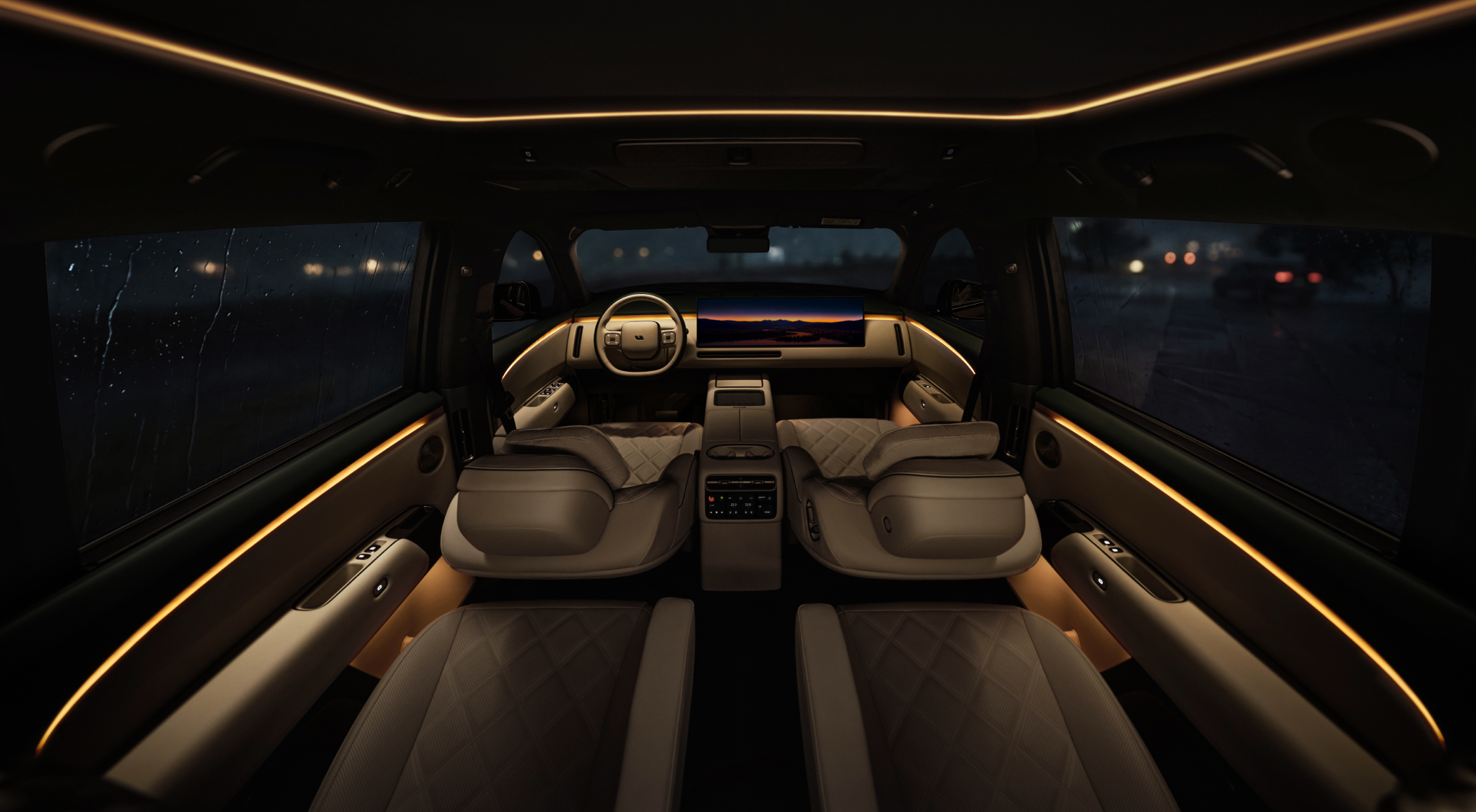
Four zero-gravity seats (two front + two second-row) represent the Livis' most compelling value proposition. With steer-by-wire eliminating the physical steering column, the front row achieves full zero-gravity ergonomics — leg rests extend up to 759.6 mm, comfortably accommodating passengers up to 190 cm tall. Second-row zero-gravity seats feature dynamic adjustment, while ABTS seatbelt architecture ensures effective restraint even in full recline — finally solving the longstanding 'recline = compromised safety' trade-off.
Seats include 18-point heated massage, ventilation/heating, and hand-stitched Nappa leather with side bolsters raised 47%. The cabin boasts 7-zone independent climate control, a 29-inch front display plus a movable 21-inch rear screen, and a 27-speaker, 9.3.6-channel 'Flawless Star Ring' audio system (peak output: 4720 W). The trunk supports electric folding of the third row — making it easy to load camping gear or oversized luggage.

Pricing & Positioning: Starting at ¥459,800 — Targeting Real Family Mobility Needs
The official starting price for the 2026 Li L9 Livis is ¥459,800. Unlike previous iterations, this update isn't about stacking specs — it's a systemic re-engineering focused squarely on core pain points of six-seat full-size SUVs: using the 800V active suspension to tame bumps and body roll; deploying the full-drive-by-wire chassis to sharpen agility; balancing energy efficiency and range via the 5C extended-range system; and fulfilling the promise of 'equal comfort for all' with four zero-gravity seats.
If your routine includes daily commuting *and* frequent inter-provincial family trips — and if you demand high-level cabin intelligence, premium chassis feel, and efficient refueling/recharging — the Livis delivers multiple 'spec-sheet advantages' as tangible, usable, and sustainable driving and riding experiences.

Conclusion: Hardware Delivered, Experience Elevated
After seven days of real-world use, what impressed us most about the Li L9 Livis wasn't any single technology — but how its suite of in-house hardware — 800V active suspension, full-drive-by-wire chassis, 5C extended-range powertrain, Mach ADAS, and zero-gravity seating — works in seamless synergy. It no longer settles for 'best-in-class specs.' Instead, it weaves 'stable handling, supreme comfort, long range, precise parking, and confident protection' into every turn, every bump, and every stretch of highway.

For users seeking premium family mobility, the 2026 Li L9 Livis is no longer 'just another Li SUV' — it's a paradigm shift for the entire six-seat full-size SUV category.
Comments
0 commentsNo comments yet. Be the first!
Post Comment