
Following Huajing S's successful entry into the ¥150,000–¥200,000 family SUV segment with high cost-performance, SAIC Motor General Motors Wuling is doubling down — its all-new mid-to-large six-seat plug-in hybrid SUV, the Xingguang L, officially launches on July 16, 2026, with pre-order pricing starting at ¥117,800–¥137,800. This price range marks the first time a six-seat mid-to-large new-energy SUV enters the mainstream household budget of ¥100,000–¥150,000, widely seen in the industry as a differentiated breakthrough against rivals such as Leapmotor C16, BYD Song Ultra.
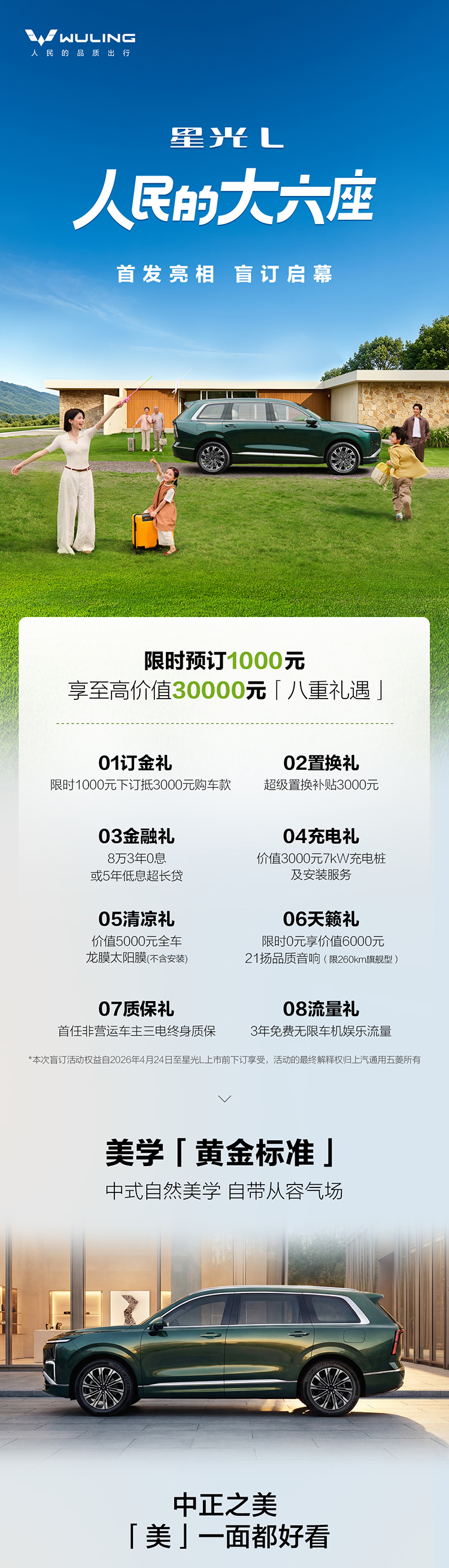
Misaligned Competition: Prioritizing Core Needs Over Feature Stacking
Unlike Huajing S, which leverages HUAWEI Qiankun ADS intelligent driving and HUAWEI HarmonySpace for technical credibility, the Xingguang L adopts a 'de-bloated, core-strengthened' strategy: it omits non-essential features like vehicle-mounted refrigerators, rear-seat entertainment screens, and adaptive dampers, while retaining what users care about most — fuel consumption in hybrid mode, fast-charging efficiency, practical interior space, and foundational safety. It's powered by Wuling's self-developed Lingxi Powertrain 3.0 hybrid system, comprising a dedicated 1.5L hybrid engine (thermal efficiency: 43.2%) and a highly integrated ten-in-one DHT, delivering a remarkably low fuel consumption of just 4.9L/100km (WLTC), a CLTC all-electric range of 260km, and a 30%–80% fast charge in only 15 minutes; all trims come standard with 3.3kW vehicle-to-load (V2L) capability and double-glazed acoustic glass.
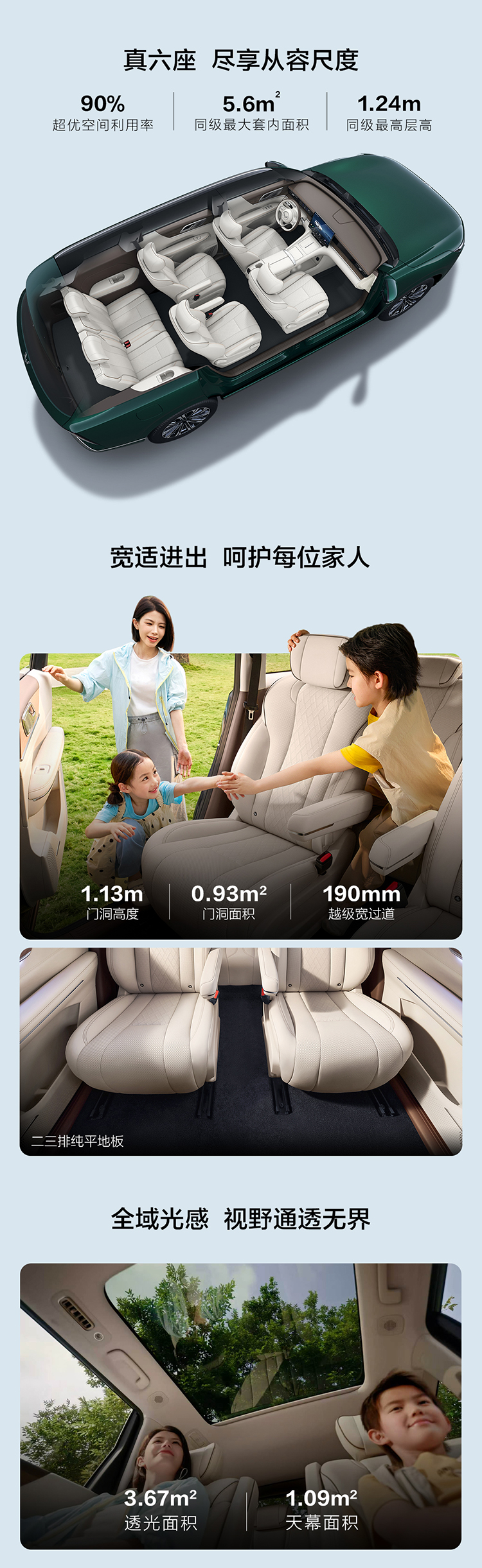
Space & Safety: Designing an Extension of Home
The Xingguang L measures 4,980 mm in length and 2,950 mm in wheelbase, adopting a 2+2+2 six-seat layout. Second-row independent captain's seats feature eight-position adjustable armrests and an 11-layer composite cushioning structure; third-row seatbacks offer 10-degree recline adjustment, expanding cargo volume to 1,103L (including a 101L underfloor storage compartment) when folded — with 40 total storage locations throughout the cabin and a standard power tailgate. For passive safety, high-strength steel accounts for 75% of the body structure, with 21 critical areas reinforced using aerospace-grade hot-formed steel rated at 1,500 MPa, plus six ring-shaped airbags.
Intelligence: Self-Developed Systems, Practical Trade-offs
For intelligent driving, the Xingguang L features Wuling's Lingmou ADAS system (standard on mid- and high-trim models), supporting adaptive cruise control, low-speed automated parking, blind-spot monitoring, door-opening warning, and automatic emergency braking (AEB); the Flagship trim adds high-sensitivity cameras and millimeter-wave radar. The smart cockpit runs the Lingyu OS, paired with a 15.6-inch 2K central touchscreen compatible with HiCar, CarLink, and CarPlay, and supports AI voice commands and remote control. Its battery is a 37.9kWh Shenlian Battery supplied by RuiPu Saik, engineered with 'Five-Zero' safety attributes (zero thermal runaway, zero water ingress, zero intrusion, zero propagation, zero leakage) and supporting 3C fast charging.
Insight: Filling a Gap, Not Replicating a Hit
The Xingguang L isn't a budget version of Huajing S — rather, it's Wuling's deliberate attempt to carve out a new segment within the ¥100,000–¥150,000 price band, grounded in proprietary technology and deep user insights. Currently, this price bracket remains dominated by five-seat mid-size new-energy SUVs (e.g., Sealion 06, C10), whereas the Xingguang L precisely targets real-world multi-passenger scenarios — such as families with three children or multi-generational households. Whether it can replicate Huajing S's near-5,700-unit monthly sales depends critically on consumer trust in its technology — despite lacking Huawei branding — and on the actual delivery capacity and after-sales network support at the dealership level.
Comments
0 commentsNo comments yet. Be the first!
Post Comment