
Recently, a set of exterior detail images of the all-new Hyundai Kona surfaced online. Internally codenamed SX3, the model signals that the current Kona will skip its conventional mid-cycle refresh and instead undergo a comprehensive generational overhaul — including platform architecture, design language, and powertrain.
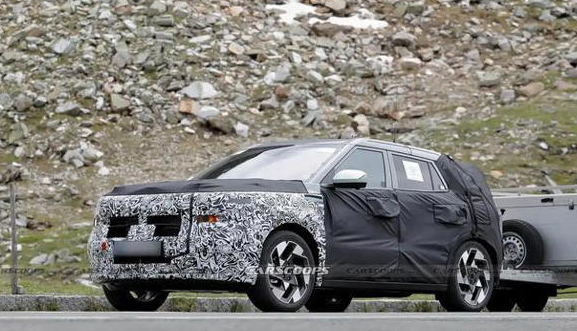
The new Kona is built on Hyundai's next-generation Pleos Connect electronic architecture — marking its formal shift toward "software-defined vehicles." As a global model, the all-new Kona targets markets including North America, Europe, and South Korea, while also launching in India under the Creta nameplate. Its overall positioning moves upmarket into the premium subcompact SUV segment.
Design-wise, the all-new Kona completely abandons the signature split-headlight layout of its first two generations, adopting a unified, minimalist, and futuristic design language inspired by — but not directly copying — the Crater concept car. Proportions are significantly refined: the hood line is raised, and the front fascia becomes more upright, softening the previous generation's hatchback-like silhouette and delivering a stance closer to that of a proper rugged SUV. The rear design mirrors the front with strong visual cohesion; top trims may feature parametric pixel-style taillights, with lighting logic aligned with the IONIQ EV lineup. Even the gasoline variants integrate electrified family design cues, such as a segmented rear bumper that enhances depth and three-dimensionality.
Inside, the all-new Kona's cabin undergoes structural reimagining — shattering the cramped-space perception typical of subcompact SUVs. Hardware specs align with those of midsize SUVs like the Tucson and Santa Fe : dual 12.3-inch panoramic digital displays are expected standard equipment, seamlessly integrating instrument cluster and infotainment; the gear selector upgrades to a column-mounted electronic shifter, eliminating the traditional center console lever and creating a bridge-style layout — with generous under-console storage space reserved beneath.
Ambient lighting, precisely integrated HVAC vents, and higher-grade materials collectively elevate the cabin toward a light-luxury experience.
Powertrain sees a historic upgrade: the new Kona adopts the same 1.6-liter hybrid system found in the all-new Kia Seltos — introducing hybrid capability to the Kona lineup for the first time. This move fills a long-standing gap in the North American market, where no hybrid Kona has previously been offered. The base hybrid variant delivers a combined maximum output of 154 hp; an optional rear-axle electric motor enables an e-AWD hybrid configuration, boosting total system output to 178 hp. The system also supports Vehicle-to-Load (V2L) external power supply functionality — expanding real-world utility.
Comments
0 commentsNo comments yet. Be the first!
Post Comment