
Design: Back to basics, with refined details
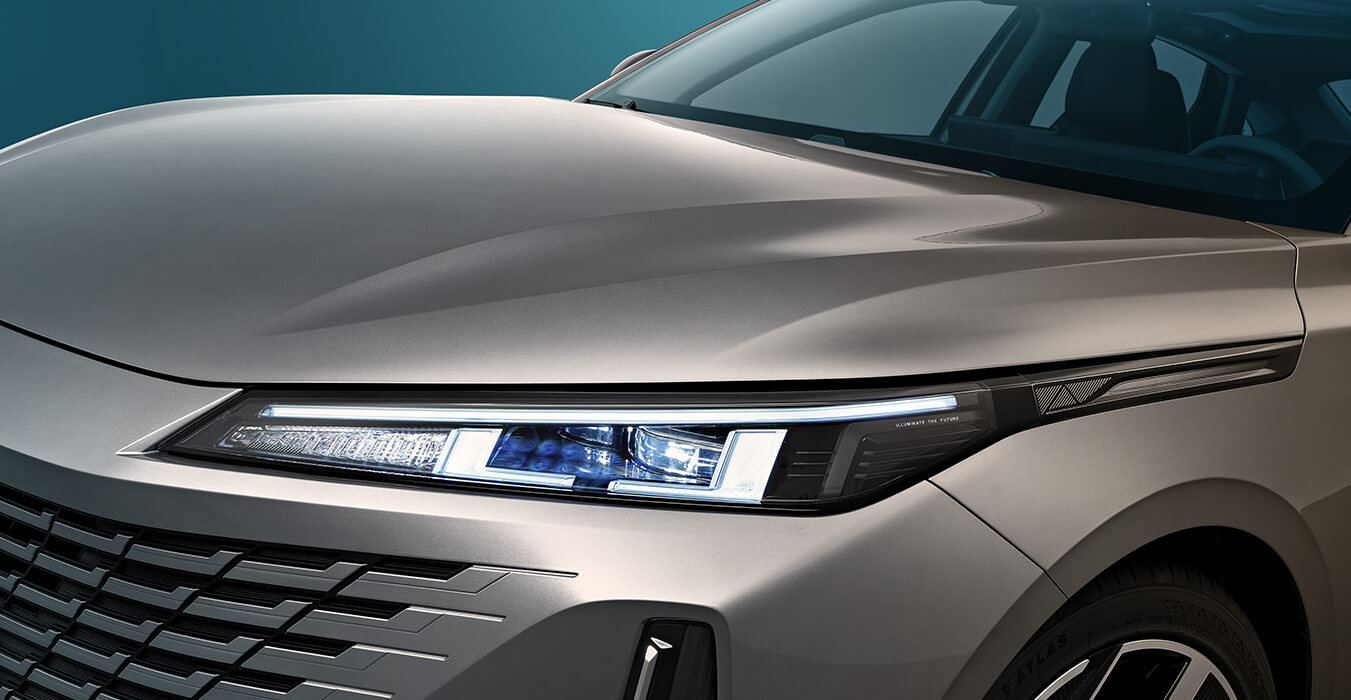
The 2026 CS75 PLUS BlueCore Hybrid retains the overall silhouette of the 2025 model — no radical redesign — but several key tweaks elevate its presence. The most noticeable change is the front grille: the previous scale-like texture has been replaced by a V-shaped chrome accent, boosting brand recognition; an active air intake grille has also been added below, optimizing both cooling and energy efficiency. Dimensions remain unchanged at 4.77 meters in length and a 2.8-meter wheelbase — oversized for a compact SUV — giving it a subtle "rearward-sitting" stance that enhances visual heft and stability.
The wheels feature an exclusive 19-inch design reserved for top trims — stylishly EV-inspired yet proportionally balanced. Tires are 225/55 R19, fitted with Chaoyang tires from the factory, prioritizing practicality over sportiness. The rear retains a high-mounted brake light and sporty spoiler, with a prominent blue HEV badge in the lower-right corner — a straightforward declaration of its non-plug-in hybrid identity.
Powertrain: P1+P3 dual-motor + 1.5T — strong electric feel, subdued surge
The powertrain shares its architecture with the Geely Monjaro L i-HEV: a 1.5T engine (150 PS) paired with P1+P3 dual motors and a 1-speed DHT transmission, plus a 1.7 kWh ternary lithium battery. Its operating logic is clear: at low-to-mid speeds and during gentle acceleration, the P3 motor handles propulsion while the engine acts solely as a generator; during highway cruising or hard acceleration, it switches to parallel mode, engaging direct engine drive.
In urban cycle testing, the electric response is exceptionally strong — zero latency, effortless lane changes and overtaking. However, mid-to-high-speed re-acceleration feels slightly soft, with limited torque reserve. This isn't a flaw — it's a deliberate trade-off favoring fuel economy over peak performance. For mainstream families, the balance of daily agility and highway composure hits real-world needs precisely.
Intelligence: Premium triple-screen layout, but ADAS demands caution
The interior keeps the triple-screen setup. When powered off, black bezels recede for best-in-class aesthetics; when lit, bezels become more visible — a common trait across the segment. Infotainment functionality is comprehensive, with full app support, though responsiveness needs polishing: map panning lags, voice recognition remains limited (e.g., saying "find spicy restaurants averaging ¥80 per person" mistakenly returns McDonald's), and boot animations slow down human-machine interaction.
The top trim features "Tianshu" high-speed navigation-assisted driving (vision-based). Its style is assertive: aggressive lane changes, tight following distance, and high traffic-flow efficiency. But "too aggressive" carries risk — minor speed increases by the lead vehicle trigger rapid closing, and emergency braking leaves little margin. In real-world testing at 80 km/h, sudden braking by the lead car resulted in weak initial deceleration from the system, requiring immediate driver intervention. We recommend setting follow-distance to maximum (two bars) on highways. Ramp recognition works, but autonomous ramp entry/exit isn't supported — the SR interface guides only to the ramp entrance before downgrading to LCC. Parking performance is solid: supports remote parking-in and key-fob activation, and handles encroached parking spaces with precision.
Chassis & Cabin: Adjustable CDC dampers, NVH among the best-in-class
The chassis delivers the biggest surprise. Top and second-top trims feature CDC adaptive dampers, with clearly differentiated Comfort and Sport modes: Sport offers crisp road feedback and taut body control — seamless over joints and bumps; Comfort delivers plush isolation, comparable to mainstream comfort-oriented SUVs. Only over large speed bumps does minor rebound and residual impact linger.
Steering feel is smooth and well-weighted — refined and premium. NVH control is outstanding: engine engagement induces barely perceptible steering-wheel vibration; cabin noise is marginally higher than the Geely Monjaro L i-HEV, yet still ranks among the segment's elite. Seat specs are generous: top trim includes heated/ventilated/massaging front seats plus a zero-gravity for all four seats; a cleverly designed fold-out table attached to the back of the driver's seat — ideal for zero-gravity use cases.
Pricing & Buying Advice: HEV dominates lineup; second-highest trim delivers best value
The 2026 fourth-generation CS75 PLUS offers seven variants: two 1.5T gasoline, one 2.0T gasoline, and four 1.5T HEV models. HEVs are the clear focus. Among the four HEV trims, the base variant lacks equipment and offers minimal price differentiation — low value. The top trim packs all features — ideal for buyers with ample budget.
The standout is the ¥129,900 "BlueCore Hybrid Flagship" (second-highest trim): priced ¥8,000 above the ¥121,900 Premium trim, it adds CDC dampers, ventilated/heated front seats, an extra ADAS camera, audio upgrade from 6 to 18 speakers, rear center armrest, and a front-center airbag. It delivers across-the-board gains — in ride quality, comfort, ADAS redundancy, and passive safety. For those willing to stretch their budget, this is the rational choice.
Conclusion: A pragmatic answer for HEV buyers
The Changan CS75 PLUS BlueCore Hybrid isn't a tech showstopper — it's a clear-eyed pragmatist. It doesn't chase range with oversized batteries or dazzle with gadget overload. Instead, it strikes a tangible balance among ride refinement, NVH control, hybrid smoothness, and fuel efficiency. While infotainment and ADAS still need refinement, chassis and powertrain improvements are unmistakable. As the market debates whether plug-in hybrids are overkill, this mature, reliable HEV reminds us: for most Chinese families, fuel economy, drivability, durability, and adequacy remain irreplaceable core values.
Comments
0 commentsNo comments yet. Be the first!
Post Comment